/Bild3.jpg?__blob=poster)
Welcome to ETHOS.HiSim’s documentation!
ETHOS.HiSim is an open-source Python-package for simulation in building energy systems, and has been under continuous development as part of the project PiegStrom. ETHOS.HiSim contains a time step simulation engine and an extendable framework for integration. The HiSim includes multiple components that as discrete elements define together the entire of a designed building energy system. Some of the current included components are Building, PV-System, Battery, Seasonal Hydrogen Storage, Gas Heater, Weather and Occupancy Load Profiles (See Fig. 1)
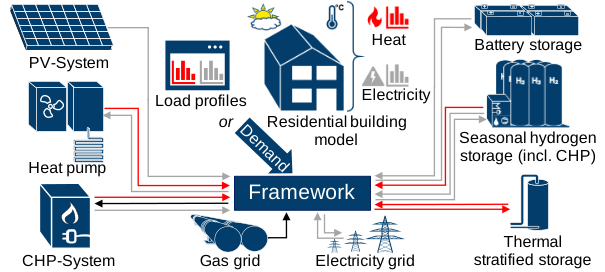
Fig. 1 HiSim Scheme
The goal of this package to enable a free fast to implement investigation of different building energy system strategies considering the many load profiles, physical conditions and alternative components from fossil fuel sources. The user can also design their own components to be implemented in its own building energy system.
Please, check the Installation procedures to install ETHOS.HiSim in your local machine.
Documentation Reference
About Us

Fig. 10 Forschungszentrum Jülich IEK-3 Team
We are the Institute of Energy and Climate Research - Techno-economic Systems Analysis (IEK-3) belonging to the Forschungszentrum Jülich. Our interdisciplinary institute’s research is focusing on energy-related process and systems analyses. Data searches and system simulations are used to determine energy and mass balances, as well as to evaluate performance, emissions and costs of energy systems. The results are used for performing comparative assessment studies between the various systems. Our current priorities include the development of energy strategies, in accordance with the German Federal Government’s greenhouse gas reduction targets, by designing new infrastructures for sustainable and secure energy supply chains and by conducting cost analysis studies for integrating new technologies into future energy market frameworks.
License
ETHOS.HiSim is distributed under MIT License .
Copyright (C) 2020-2021 Noah Pflugradt, Vitor Zago, Frank Burkard, Tjarko Tjaden, Leander Kotzur, Detlef Stolten
Contribution
This software is developed together with the Hochschule Emden/Leer inside the project Piegstrom and 4wardEnergy Research inside the EU project WHY.
Acknowledgement
This work was supported by the Helmholtz Association under the Joint Initiative Energy System 2050 - A Contribution of the Research Field Energy .

For this work weather data is based on data from German Weather Service (Deutscher Wetterdienst-DWD), individual values are averaged.

This project has received funding from the European Union’s Horizon 2020 research and innovation programme under grant agreement No 891943.